The E-Concordance of Nārāyaṇa Bhaṭṭa‘s Prakriyā-sarvasva and Pāṇinian grammars by Jan E.M. Houben et al. (ECPG 1.0 see below) is supplementary material to L’Inde classique section VIII.1.a 1519-1532 on the Sanskrit grammarians. This section written by Louis Renou which appeared in 1953 contains no reference to the Prakriyā-sarvasva by the brilliant and versatile author Nārāyaṇa Bhaṭṭa of Melputtūr (17th century). However, Louis Renou was at that time already well aware of this grammar, since we read in the Preface to S. Venkitasubramonia Iyer’s Nārāyaṇabhaṭṭa’s Prakriyāsarvasva; a critical study, which apeared in Trivandrum at the University of Kerala in 1972, the following: “Then I conceived the idea of studying the entire work … which I was encouraged to pursue by the well known Indologist Prof. Louis Renou, when he visited Trivandrum in 1948.”
Regarding the nature and importance of the Prakriyā-sarvasva we can now also refer to:
J.E.M. Houben “Pāṇinian grammar of living Sanskrit: features and principles of the Prakriyā-Sarvasva of Nārāyaṇa Bhaṭṭa of Melputtūr,” Bulletin d’Etudes Indienns (BEI) vol. 32 (2015), pp. 149-170.
E-Concordance Pāṇinian grammars: ECPG.01
The concordance allows students and specialists of Pāṇinian grammars to find back the place of a rule or sūtra in the eight books of grammatical rules of Pāṇini, the Aṣṭādhyāyī (AA), in one of the two rearranged grammars (and vice-versa): the well-known and widely studied Siddhānta-kaumudī (SK) and the largely and unduly neglected Prakriyā-sarvasva (PS). The place of a rule or sūtra in each of these three grammars is highly significant, as it provides information on the interpretation and function of a certain rule in the entire grammar. Especially the Prakriyā-sarvasva provides very clear headings for 20 major groups of rules, as announced in the introductory verses 6-7 :
iha sañjñā paribhāṣā sandhiḥ krt taddhitāḥ samāsāś ca /
strīpratyayāḥ subarthāḥ supāṁ vidhiś cātmane-pada-vibhāgaḥ //
tiṅ api ca lārthaviśeṣāḥ sananta-yaṅ-yaṅlukaś ca subdhātuḥ /
nyāyo dhātur uṇādiś chāndasam iti santu viṁśatiḥ khaṇḍāḥ //
“There must be twenty sections (khaṇḍāḥ) in this (work) :
I. sañjñā-(khaṇḍaḥ) – (section on) technical terms
II. pari-bhāṣā- – metarules
III. sandhi- (or saṁhitā-) – phonetic modifications where morphemes and words meet
IV. krt- – primary suffixes
V. taddhita- – secondary suffixes
VI. samāsa- – compounds
VII. strī-pratyaya- – feminine suffixes
VIII. sub-artha- – the meaning of nominal endings
IX. sub-vidhi- – rules for nominal endings
X. ātmanepada-parasmaipada-vibhāga- – distinction between active and medium
XI. tiṅ- – verbal endings (according to ten present-classes & according to ten la-kāras of times and modes)
XII. lārtha-viśeṣa- – particularities in the meaning of the la-kāras
XIII. san-anta- – desideratives
XIV. yaṅ- – intensives
XV. yaṅ-luk- – intensives without -ya-
XVI. sub-dhātu- – denominatives
XVII. nyāya- – rules and general principles in the derivation of forms
XVIII. dhātu- – verbal stems: “roots”
XIX. uṇādi- – suffixes for the formation of nominal stems (apart from krt and taddhita suffixes, etc.)
XX. chāndasa- – rules for the accents and for the vedic language.”
Acknowledgements and credits: The contents of the ECPG is based on work done within the framework of “ANR 11 BSH2 003 03, intitulé PP 16-17 : Pāṇini et les Pāṇinéens des XVIe-XVIIe siècles” (Profs. François Grimal and Jan E.M. Houben, EFEO, IFP, EPHE-PSL), by Dr. Viswanatha Gupta under the guidance of Prof. Dr. Jan E.M. Houben.
The transformation of the material into an e-concordance is the result of the project “E-Concordance grammaires pāṇinéennes (ECGP) : Prakriyā-sarvasva (PS) – Siddhānta-kaumudī (SK) – Aṣṭādhyāyī (AA) selon la Kāśikā”, Action Ponctuelle, 2018 (approved 18 October 2017) by Dr. Anil Kumar, under the guidance of Prof. Dr. J.E.M. Houben (EPHE-PSL, Paris) and Prof. Dr. Amba Kulkarni (Department of Sanskrit Studies, Hyderabad University, India).
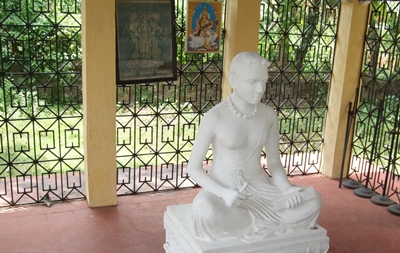
The featured picture shows Narayana Bhatta of Melputtur as represented in a statue near Melputtur, Kerala. Note the Nambudiri purvashikha. Picture by J.E.M. Houben, 2012.